Saturday, July 2, 2022

Review of "Illusion of Control"


 Kenny recently published a new book!  It's called "Illusion of Control".  This book is a post-apocalyptic retelling of the biblical story of Samuel, Saul, and David.  The blurb on the back summarizes it well:  "In the postapocalyptic city of Gog, Wu was a great king, until he lost his faith, and then his mind, and then his kingdom.  In Gog, your worst enemy may turn out to be your best friend, and the most dangerous thing you can do is fall in love.  Illusion of Control is an urgent parable about why we live together and how societies fall."  

This is a great read!  Here are my favorite things about it:

  • Reno setting, and rich descriptions in general - This book is set in Reno.  Those of you who are familiar with Reno will enjoy descriptions of specific places around town and the haunting (but also sometimes beautiful) images of what our region might look like in a post-apocalyptic future.  Kenny creates very evocative descriptions, so you can really see places and imagine scenes playing out in your head.  
  • Classic story set in futuristic times - This is kind of like if you've ever seen a Shakespeare retelling set in modern times.  The bones of a really good story are all in there, but because it's set in a dramatically different time and place, you notice new and different things, and you can also appreciate the original story in a whole new light.  
  • The technology aspect - Kenny takes advantage of the futuristic setting to bring in nanotechnology, and uses it to make some unexpected plot twists and to bring up some really interesting questions about the intersection of technology and faith.  You could do a whole book club about this aspect alone, but I don't want to get too deeply into it and cause spoilers.  Other than to say that I think Yuel's quote on p. 528 nicely summarizes how the technology stuff fits with some of the religious questions it raises.
  • Well crafted, action packed plot - The plot weaves together really nicely from beginning to end, with a complex structure that builds as it goes.  There is lots of action and a fair amount of violence, which is true to the story it's based on (and this made me appreciate what it would've been like to be alive during the days when there was either battle or the threat of battle around every corner).  I will say that violence is not my favorite, but here I found it to be like Breaking Bad - it builds the story arc and helps drive the character's moral development; it serves a purpose.
  • Character development - This was my very favorite thing!  Kenny really develops the characters.  When you are a kid and learn these stories, they can seem pretty one dimensional.  Saul = bad guy.  David = good guy.  Etc.  Here, you get to imagine more of a back story.  Saul as the guy who grows up in a very troubled, poverty stricken home.  Who's at least sometimes trying to do the right thing, as life hammers him down.  Who ultimately succumbs and breaks down based more on weakness than the stereotypical evil-through-and-through movie villain.  David as the guy who's very brave and heroic, but also brash and impulsive and headstrong.  All of the characters are built out more, and feel like real people.  The Samuel and Jonathan characters are great.  The three leaders of the enemy people are all very compelling, particularly the woman who invents the technology.  I really enjoyed getting to know these characters. 
  • Cliff hangers at the end leave you wanting more!  My sources tell me that a sequel is on the way.

So, in conclusion, you should check out Kenny's new book!  You can get a paperback copy or a (free!) ebook at this link.  And you can check out more of Kenny's creative work here.

Tuesday, June 7, 2022

Thankful for Our Village At Sarah Winnemucca


First day of elementary school


Last day of elementary school!

Josh officially ended his time in elementary school today.  Because he started in preschool, he has been attending elementary school for NINE years - most of his life, and more than most of us stay at any one work place these days!  I was so scared to send my tiny, vulnerable, three year old to this enormous school building - his backpack weighing almost more than him as we passed by the upper grade kids who looked like giants.  That first day, I just didn't know how in the world it was going to work at all.  I am thrilled to say that this first, and biggest, chunk of school has gone great:  we have seen him grow so much in every way - physically, emotionally, academically, socially - and it's largely thanks to the village of adults at the school.  So this post is an ode to all of Josh's elementary teachers and teams, with all the reasons I think you're great!

First, we've been so blessed to have great general education teachers every year who come up with creative ideas that make the kids want to go to school and want to learn.  These teachers have done everything from guided art drawings to a passports around the world project to read alouds with great books that the kids can't wait to hear what comes next in the story to making the classroom a town with its own economy and everyone has jobs.  I've loved Josh's teachers so much each year that I always request to get them for Zoey too (and they've been great in teaching her too! - I could write a whole separate post about what a help and encouragement they've been in developing her love of reading and writing - but for today, I'm focusing on Josh's experience).

Second, we've had an IEP team and administrators who have given him a robust IEP that supports all his needs without making it a fight.  I've talked to tons of families both in and out of our school district and know exactly how rare this is.  All the support has been a huge blessing to him, and the without a fight has been terrific for me :).

Third, the school staff really got to know him.  Everyone knew the kinds of topics and books that projects that would be of most interest.  As an example of this:  there were a couple years where Josh was really into bridges, and the Tacoma Narrows bridge collapse in particular.  This bridge collapse from the 1940s was caught on video and is sometimes used to teach college engineering students about aeroelastic flutter - Josh enjoyed watching it and could tell you all about the physics behind it.  Anyway, the school used to do science days, where students would go to different classrooms throughout the day and learn about different science related topics - one of the presentations on offer that year was his favorite, the Tacoma Narrows bridge collapse video.  Josh came home so excited, and I'm not sure exactly which teacher or staff made this happen, but what a wonderful thing.

Fourth, they believed in him and they operated from a growth mindset.  They started where he was at, but also saw where he could go, and consequently, we saw great growth.  It would be easy to go through the motions and provide services without any heart, not really believing in the student's ability to make progress.  We never had this - we always had team members that cared, that believed growth was possible, and we consistently saw progress.

Fifth, the school really prioritized treating everyone with kindness, and consequently we had really good experiences through the years with both staff and students valuing and including my kid.  The former principle deserves huge credit for setting this tone, along with all the teachers and staff for living it out day after day.

I can easily imagine a different school experience where any of these things weren't true - where we had to deal with bullying, or fight for our kid to get the same kind of education as others, or where school was just a miserable thing.  I am extremely grateful to all the teachers who put in the extra care and extra effort (even in challenging covid years!) to make these elementary years so great.  Thank you, from the bottom of my heart.  There really aren't words to adequately convey how much this means to me.

I hope you all have an awesome summer!  Maybe we'll cross paths in the Sierra Nevadas!  I wish you all the best.


Tuesday, May 10, 2022

Running Post, 2022 Edition

One guarantee about race photos:  they *will* be goofy.  Finish line happiness right here.


 I ran The Biggest Little Half Martahon last weekend, so that means it's time for another running post!  I know running is not everyone's cup of tea, but if it's any consolation, at least it's not politics :).  This post will have some thoughts on the unique contours of running during covid, and training as an over 40 runner.

Running During Covid:  Don't It Always Seem to Go, that You Don't Know What You Got til It's Gone

This was my first race of any kind for 3 years.  I had planned to run this same half marathon in the spring of 2020, and had worked my way a good way up the training ladder (meaning, doing longer and longer training runs on the weekend), and then covid rolled in and shut everything down.  All races were cancelled throughout America for the rest of 2020 and into the early part of 2021.  

Despite the pause in racing, running was a terrific outlet during covid.  It was really a great boredom and anxiety reliever, especially during the spring and summer of 2020.  Those early weeks, I would go out on the trail by our house almost every night - thankfully, it was never very busy, and it was easy enough to keep a gaiter around my neck in case I happened to run into people.  Running was about the only thing I did outside of the house, and it provided endorphins from exercise, Vitamin D from sunshine, some peace and quiet for this introvert, and a chance to enjoy beautiful nature.  Those evening runs through the canyon were great, even on days when the running part itself was hard.


By late spring / early summer of 2021, races started to appear back on the scene, but there were still problems:  some of the small businesses that put on races weren't able to stay in business after a year of no races, so there were fewer races happening; the numbers of participants and volunteers were (understandably) still very low, and meanwhile cities (understandably) had all kinds of extra rules about masking and social distancing and other covid protocols, so races often got cancelled at the last minute; and you didn't know exactly if and when your own family was going to get hit by covid and then you lose 6-8 weeks of training and your entire fitness base.  I started to train for a few races in the fall of 2021, but for all these reasons, didn't end up running a race.  

Race day outfit!


So it was really, really, really exciting this spring to see races returning in all their glory, with full participation and no restrictions.  The whole ritual of race weekend is fun: picking up the packets; carbo loading the night before, then laying out your outfit; lining up at the starting line with a throng of people, then taking off together at the starting gun; running past the supportive people blasting music or
holding up funny signs; grabbing a water from the aid station and trying to drink it without choking; struggling through those last few miles and swearing you'll never do this again; running the last block as hard as you can and feeling glorious as you cross the finish line; collapsing somewhere nearby until your legs feel capable of moving again; congratulating fellow finishers and just being around hundreds of other people who find this strange, beautiful, torturous race a good time.  Cheers to the Biggest Little Half, and cheers to the return of half marathons!

Running After Age 40

This was my 5th half marathon.  I did the first two in my 20s, and I think that version of me would be shocked to know that I was still running half marathons decades later.  I first tried it out because I wanted to see if I could do it and I wanted to have the experience with my mom (who is an awesome runner with a PR that I am still chasing, and who gave me the running bug!).  I did follow a training plan, but I don't remember giving a single thought to things like what should I eat (other than, it made me super hungry and there were lots of Dairy Queen blizzards), how much should I sleep, or how should I stretch and recover.

Like eating toothpaste style nutrition supplements in the middle of the run!

That's the big difference, running in your 40s - you give lots of thought to all these things.  If I eat fast food or drink alcohol the day before a long run, it's not going to go well.  If I don't get 8-9 hours of sleep, same thing.  (This might've been true in the days before kids, too, but it's not as hard to do before kids :).  As far as recovery:  I stretch my hamstrings now about ten times a day, we have 4 ice packs in our freezer, we have a Theragun ready to go for sore muscles, and turmeric is one of the regular daily vitamins.

The other thing that's different about running at age 41 is that I realize each training cycle where I'm healthy enough to run is a gift, not a given.  God willing, I have decades left of life, but not necessarily decades of endurance running - you don't know when the injury or health issue will hit that brings this chapter to a close.  So it makes me increasingly grateful each year that my body is able to support this effort, and it makes me want to give a full effort on race day.  

Having said that -- this is also a really fun, inspired year to be a middle aged runner.  New female American records for both marathon and half marathon were set this last year --  the half marathon record is now held by Sarah Hall, mother of 4, who achieved the record  at age 38; the full marathon record is now held Keira D'Amato, mother of 2, who achieved the record this year at age 37.   These women give me hope and inspiration that if they can run their strongest at this age / life stage, then many of us non-elite runners at a similar age / stage should also be able to give it a strong go.  So I'm not saying that my running years are necessarily close to over, or even that I'm ruling out a PR in the future.  Just that I'm increasingly thankful for the gift of a healthy body as the years tick by.   (Note:  in the week between when I started this post and got around to finishing, a new record was set in the women's half - but the point still stands.)

If any of you reading this are runners, tell me:  what's your favorite distance to race?  What's your favorite part of the race?  


Thursday, April 7, 2022

So Raise a Glass to the Turning of the Seasons


We are on the brink of some big transitions in our family!  Ivy will start kindergarten in the fall, marking the first time in almost 12 years that I haven't had at least one kid full time at home with me.  (Josh will also be starting middle school!!)  This means I will have some hours open up during the day, and we will have some decisions to make about what's the best way to fill them.  Even though this won't happen for several months, I've been thinking about it a lot lately.  This post isn't going to make any big announcements, but is more of a "some things I've noticed while I'm processing the upcoming transition".  I'm hoping this might be relatable to anyone who is making a life decision (going back to work, changing jobs, retiring; relationships, having kids; significant changes to time or budget; really any big change).  Three things I've noticed:

 1.  Transition times make you think about your big life values.    Life is busy.  Most days, we're just trying to stay afloat with "what's on today's schedule / to do list / dinner menu"?  Making it through each day feels like it takes everything we got, and there's no time or energy leftover to map out a 5, 10, and 20 year plan.  But when you're at a crossroads and need to make some life choices, you find the time to evaluate the big things.  What's important to me in my relationships with my kids, my closest family and friends, my people?  What is my north star, the thing(s) that matter most to me in who I am and what I want to be and do with this life?  What are my financial needs and goals?  And how does all this square with the decision in front of me?  (For me, the biggest life goals are to love God and love others - there are a variety of ways that this could play out, but this is my north star.)

As someone who regularly overthinks things (see #3), it might seem like I'm thinking about these things all the time, but my natural tendency is actually much more to take the situation that I'm in and try to make the best of it.  I'm not great at envisioning the future, goal setting years in advance, or making big and scary changes.  But man, what an important skill to get better at, and these transition times are natural opportunities to work on this skill set.

2.  The input coming in hits disproportionately strongly during transitions, so it's a time to be extra careful about what you put in your head.  When I'm thinking about how to structure the next phase of my life, it can be easy to start listening closely to everything that passes into my ears or before my eyes and take it as a sign, to take everything to heart.  Like, "Ooh, here's a catchy quote on Facebook, let's take this as direction and proceed accordingly."  When I'm in a decision making phase, I try to heed this advice:  "It pays to keep an open mind, but not so open your brain falls out."  Knowing that I'm extra susceptible to ideas right now, and probably for the next several months, I'm mindful to keep an eye on whose advice I'm taking in.  Is this a trusted source?  Do their values align with mine?  And even if so, do their input square with my big picture goals that I just worked out in Question #1?  The best advice I've been getting from (multiple!) trusted sources is this:  "It doesn't matter as much what you do, but who (and whose) you are."

3.  Don't overthink it! I'm literally writing a blog post about my "process", so as you can see, there is a built in propensity for overthinking up in this brain.  What I mean by "don't overthink it" is:  do the steps above - think about your values, seek input and choose good influences to help you in that process.  Pray about it.  BUT.  There is definitely a point where you can stew too much.  While planning and preparation and prayer are not a waste of time, worrying that extends beyond these things is absolutely a waste of time.  At some point, you do just need to make choices and then move forward.  Big structural decisions should be made carefully, but they don't have to be final - if something isn't working, that's a signal to figure out a way to make a change.  And the biggest thing, with regards to overthinking (and taken straight from my church's James study, the end of chapter 4):  we don't know the future, and we don't control the future.  I never expected to be a stay at home mom, none of my educational preparations went that way, but life circumstances led a different direction.  I do need to make plans and preparations, but they need to be held humbly and loosely, knowing that God might have a different path in store for me.

So these are my thoughts as I approach a transition.  I know several who read this blog have been through transition times, and I would welcome your words of wisdom in this process!


P.S.  Even though this post is purposely written in general terms, it should not go without saying that it's a privilege to be able to think about whether and what kind when it comes to jobs, and I'm grateful for this.

Saturday, March 5, 2022

All About Sky Tavern


This winter, my family entered the world of downhill ski for the first time.  We had a really good experience, so I wanted to write more about it for those of you who also live in Northern Nevada and are wondering about learning to ski and Sky Tavern in particular.  For those of you reading along who have also done it, feel free to add on in the comments!


What is Sky Tavern?
Sky Tavern is a nonprofit learn to ski program.  They have their own ski resort, near Mt. Rose.  They offer around 8 weekends of skiing each winter (this depends on the snow, since they don't have a snowmaker - some years will be less, this year we are getting 10+ weeks).  Each family must have at least one parent come up with the kids (unless your kids are ages 9+ and signed up as a bus kid), and this parent must spend at least 2 hours per day volunteering.  What most families do is choose one weekend day and come up every weekend on that day - the morning is required kid's lessons / adult volunteering, the afternoon is optional free ski.  You can do both weekend days if you choose (but you have to do lessons / volunteering every day you go up), and there are occasionally extra days of free ski offered.  


What's Awesome
- The ethos:  All the leaders of the program are so positive and enthusiastic.  They love kids, they love skiing, they love this program, and they will likely have won you over to this mindset by the end of things.  They want to bring confidence and joy and love of outdoors to kids as much as they want to teach skiing skills, so it's not a high pressure program.  It's largely run by volunteers and this can be pretty chaotic at times, but it really does work - most all of the kids on the mountain will make good forward progress in skiing skills from week to week.  One thing that's funny is that this program is by far the most Midwestern-minded of anything I've seen out west (which is ironic, since it's skiing) - it's like a barn raising - there is a huge emphasis on everyone helps out, everyone pitches in, it can't get done without everyone doing their part - and this communal aspect is part of the beauty.  
- The cost:  I will go into this in more detail below, but the cost is a fraction of what it will be at any other ski resort. 
- The inclusivity:  They say that they want every kid to be able to learn, and they mean it.  For my family, I have especially appreciated their amazing adaptive program.  They will get your kid the gear and adult support they need, take them through the learning process with the support and pace needed, and be SO positive and encouraging throughout.  We've done several adaptive sports programs now, and this is among the best.  I'll attach a video of Josh skiing - note that he's going on his own, grinning from ear to ear, and being enthusiastically supported by a couple adults.  I love love love this part of the program, in a my-heart-is-exploding kind of way.  So much appreciation for the leaders, instructors, and volunteers that make adaptive skiing possible.  
- Parents can learn too:  This is optional, but if you have any inkling of interest in learning to ski, it will be strongly kindled once you get up on the hill.  They offer adult lessons for free in both the morning and afternoon, and they will start at whatever level you're at.  They don't offer child care, so if your child isn't at the point where they can free ski or hang out without supervision - which two of my three are not, so I had to rely heavily on friend and family support to make this happen - then you will have to figure out a plan.  But when you get up on the mountain, see your kids getting the hang of it, realize you've already done the hard work of getting up there and that lessons are there for the taking, it will make you want to take advantage of the opportunity.  I'm grateful to those who helped me make this happen!
- The activity of skiing:  It's really fun!  It's not as hard as it looks, at least getting good enough to go down the easiest hills.  It's a great way to get fresh air and have a fun outdoor activity during the doldrumy winter months.  As Zoey says, "it feels like freedom".  I wasn't sure that any of us would make progress or enjoy it - as it turns out, all four of us made progress, and all four of us enjoyed it and want to do it again next year.  I will go into the hard parts below, but I want to make sure to emphasize that we loved it, and overall the pros far, far outweigh the cons.  

What's Hard
- Volunteering:  As mentioned above, every adult is required to volunteer for 2 hours per day.  There are some inside the lodge type positions, but they really want as many adults as possible helping out with the kids on the snow.  Depending on which program your kid signs up in, you might be required to volunteer with that program.  I helped with the Sky Kids, which is the 3-5 year olds.  In this one, you are assigned to a Pre-K kid who is not yours and you help them learn.  The kids themselves were usually quite funny and cute and nothing more difficult than wanting lots of breaks and lots of gummies.  But the physical demands of being a crash test dummy and lifting a kid out of the snow 100 times are a lot - I tweaked my back that first week (it gets easier as the kids get better).  And to me it felt really strange trying to "teach" when I had literally never been on skis for the first month, like the kids who got me as their helper were getting the short straw on instruction.  (There were plenty of others who were helper instructors that didn't know how to ski, and it actually does work since a) there are certified instructors supervising the helpers and b) what the kids really need is time on the snow to practice more than the most experienced and knowledgeable instructor of all time.)  So depending on your volunteer assignment, it might be pretty physically demanding and out of your comfort zone - there is an argument to be made that this is good for us, and I actually did grow more comfortable and loved watching the kids make progress and enjoy themselves - but in any case, it's something to know and keep in mind.  
- Early times - For many, the weekend is the one time of the week where you can wake up without an alarm and have a relaxed morning.  If this is something you really value, this may not be the program for you.  Classes start at 9 am - this means that you're waking up at 6 am to get out the door at 7 am to get on the mountain by 8 am (for parking, getting gear on, checking in, etc.)  The first few weeks, you're driving up the mountain at sunrise.
- So much gear - There is soooo much gear with skiing, exponentially more than any other kid activity.  With every person who's skiing comes:  skis, ski boots, ski poles, ski helmets, ski goggles, ski gloves, ski pants, ski socks, snow boots, and layers of warm weather clothes.  As the weeks go on, you get a system in place for getting out the door, but it's a lot.  (If your kids are younger, or adaptive, or just getting used to the ski boots, I highly highly recommend bringing a collapsible wagon as well, to transport all the gear from your car to the lodge, and getting set up right next to the ski hill.)

The Cost 

This breakdown might be a little crass or boring for some, so feel free to skim past this section - but I'm hoping this will be helpful for a few.

Each child is $150 for the season for lessons / access to the lift.  If you rent ski gear from Sky Tavern, this is $50 per kid for the season.  (Note that $200 for a weekly activity spread over 2-3 months is very comparable to the cost of any other sport, and from what I've heard, about 1/6th the price of the other ski resorts.) (I would definitely rent rather than buy equipment for the kids, since this price is so reasonable and they will change sizes from year to year.)  Parents who go up on the mountain also have to buy the $150 pass (which includes lessons and lift for you too, but you have to buy it whether or not you actually ski).  Parents can't rent gear from Sky Tavern.  If you do a season rental from Bobos, that's $300 for all the stuff.  If you buy it used (available at the ski swaps, Craig's List, or Bobo's), you can also expect to pay $200-$400.  If you buy skis new, the whole package will be closer to $1,000+.

As far as the other ski specific gear - we got helmets for $40 per person, goggles for $35 per person, ski socks for $30 per person, ski gloves for $10 per person.  (If you get these things from the ski shop not during a sale, they will be more, so it pays to plan ahead.)  The good things about all of those things is that once you get them once, they should last for several seasons.  


Other Closing Thoughts
- Be ready for first couple times to be hard.  When all the gear is new, and standing on skis is new, and being out in the snow all day is new - it all just takes some getting used to.  The first couple weeks will be more work than fun, but the fun to work ratio gets way better if you stick with it.
- Sky Tavern really wants to make it possible for everyone.  I didn't know how it was going to work for our family, with three brand new kids (one with special needs) and a clueless adult - we were the hot mess express that first week - but it worked!  If it worked for us, it can work for you!  
- We loved it!!  If you think you might like it, give it a try!

Tuesday, March 1, 2022

Day 30: What Experience this Month

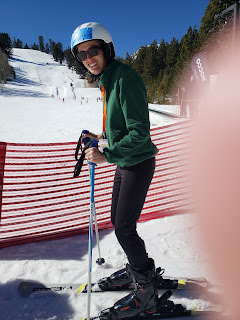
Skiing in 60 degree weather


What experience this month are you grateful for?

This month, I'm grateful for skiing!  I'm so grateful for all activities that get us outside together as a family, and I'm especially grateful for this one because it got us out regularly in a season when we tend to just hole up in the house, and doing an activity that we will be able to continue to improve at and enjoy for many years to come (and how often as an adult do you get to pick up a brand new activity that is so much fun?!).  I'm grateful that this activity worked out for all four of us, which is not a given when you try anything new.  I'm especially grateful for the friends and family who helped out with the kids so that I could take lessons and have practice time - it takes a village!  I'm grateful that we live so close to mountains, which makes it much easier to participate.  And I'm grateful that Sky Tavern made it so accessible and affordable for a family of complete and total newbies.  (A few of you have asked for a lot more details about Sky Tavern, so I'll write up a longer post soon.)

That concludes the 30 days of gratitude posts.  Thanks to the small but mighty crew of you who have followed along (and extra special thanks to the couple who have participated with me) - it really did bring cheer to this month!

Monday, February 28, 2022

Day 29: What Bill


What bill are you grateful to pay?

This is a funny prompt.  The knee jerk first response is, "none".  And then, when you start thinking about what you receive in return for the bills you pay, the next answer is "(almost) all".  This morning, the bill that's standing out to me is the garbage bill.  Garbage is a subject we hardly have to think about, except remembering once a week to get the bin out to the curb.  But if you live in areas or countries without this service, you have to do a lot of thinking about garbage - burn it?  Bury it?  Live with a bunch of junk around?  It provides major public health benefits to have garbage disposed of so efficiently, it keeps things more beautiful and orderly, and it just makes life way easier.  I'm thankful for the waste management workers and the whole waste management system.