Thursday, December 29, 2022

Books I Read in 2022

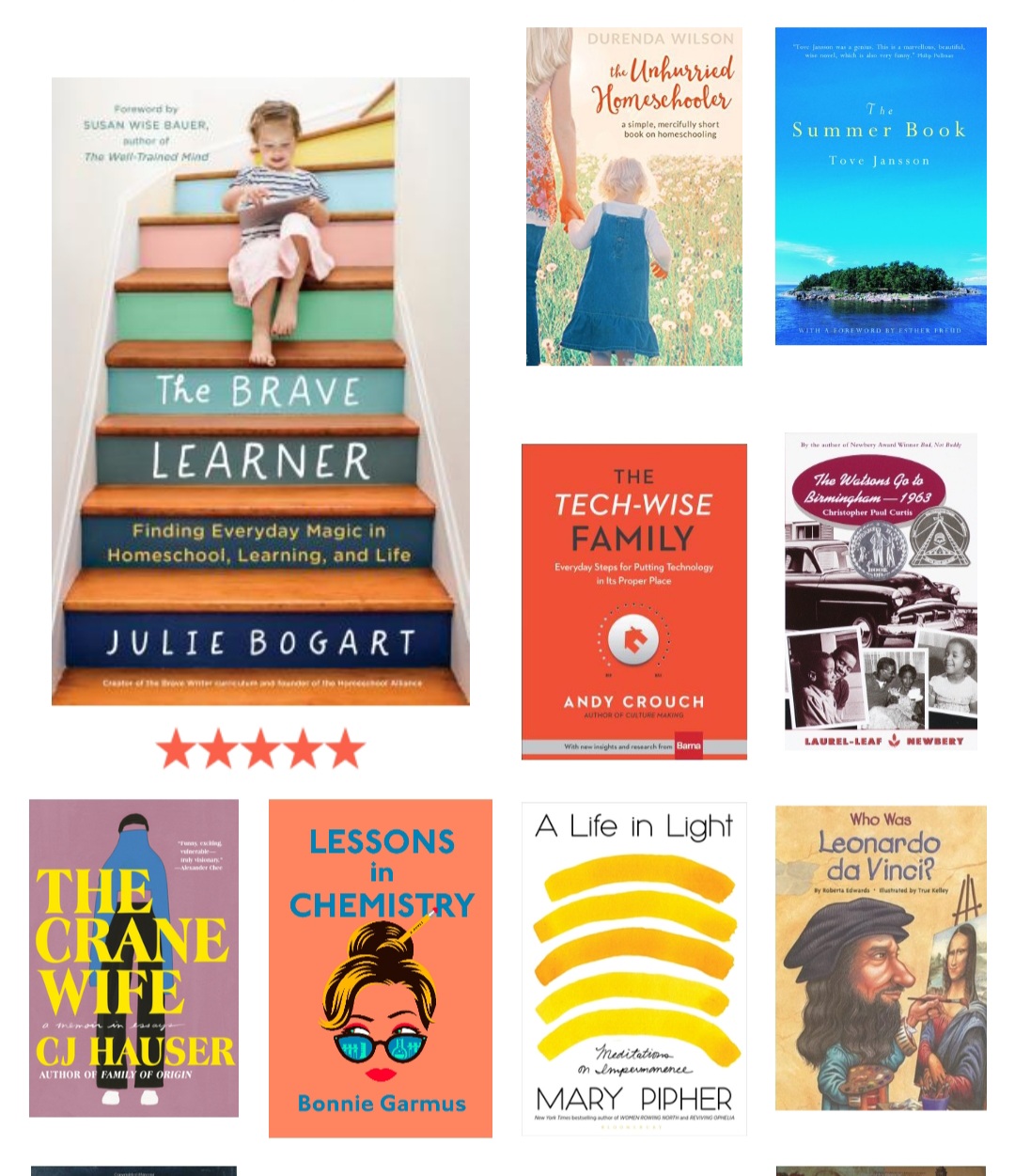
Welcome to my annual favorite books blog!  I look forward to this one all year - it's fun to remember favorite books from the last year, and it's fun to hear from you about what you also enjoyed.  Here's pics of the books I read in 2022 (thanks Goodreads!), and here's a link if you want to learn more about any of them. Scroll down to see the list in writing!


First, I want to give a shout out to libraries.  Libraries, we love you!  I counted, and 47 of my books were library books this year.  And this doesn't count the many dozens of picture books we've checked out to supplement all the homeschool subjects, or cookbooks I previewed before buying, or (new this year!) sheet music that I attempted to play before realizing it was way beyond my abilities.  It also doesn't quantify all the story times we attended when the kids were toddlers, the craft projects and art displays and therapy dog visits we've happened upon when stopping by, and the warmth of the friendly librarians who make all of this happen.  Thank you, librarian workers, for all you do for our communities, and thank you libraries for the plentiful supply of books.

Now, we turn to my favorite books of the year!  I want to add - every book that appears above I would give a thumbs up in one way or another.  I quit early on if a book's not hitting for me, so if it makes it on the "read" list, then there was something compelling about it.  And I would be thrilled to discuss any of them, above or below.  Having said that, these are the ones that stayed with me the most.  Here we go...

Middle grade:

"The Silver Chair" and "The Last Battle" by C.S. Lewis

"Pony" by R.J. Palacio

"From the Mixed Up Files of Mrs. Basil E. Frankweiler" by E.L. Konsburg

"The Ickabog" by J.K. Rowling

Books I'm still Thinking About:

"Even Better Than Eden" by Nancy Guthrie

"Why God Makes Sense In A World that Doesn't" by Gavin Ortlund

"The Brave Learner" by Julie Bogart

"The Tech Wise Family" by Andy Crouch

"Meditations" by Marcus Aurelius

"Out of the Silent Planet" and "Peralandra" by C.S. Lewis

Favorite books where you get swept up in the story:

"Illusion of Control" and "Loyal 2 Chaos" by Kenny Ching

"Greenwood" by Michael Christie

"Love and Saffron" by Kim Fay

"Remarkably Bright Creatures" by Shelby Van Pelt

"Lesser Known Monsters of the 21st Century" by Kim Fu

Amazing Writing:

"A River Runs Through It" by Norman Maclean (specifically the first story)

"To Bless the Space Between Us" by John O'Donohue

"One Long River of Song" by Brian Doyle

"The Power and the Glory" by Graham Greene

"Small Things Like These" by Claire Keegan

One Miscellaneous Other That I Really Liked:

"What I Talk About When I Talk About Running" by Haruki Murakami


These are my favorites of the last year!  Please tell me if you've read any of these and what you thought, and also what books you've read recently that you loved.

Sunday, December 11, 2022

Light in Darkness

It's time for the annual Advent post!  I want to start off by saying, thank you to all of you who read this blog.  Like for many of you, our holiday season gets pretty crazy, and most of the thoughts that run through my head are more of the "to do list" type than the "reflection" type.  (Like:  "Are Christmas cards still 40% off?  Did I get the right shade of lipstick for Ivy's holiday recital?  Did I get the white elephant gift for this gathering, make the cookies for that one?  What events will make this holiday season fun for the kids?!?"  Etc.)  It's easy to lose the forest for the trees, and so it's a gift to have this space to do a little reflection, and it's an even bigger gift to have people to share it with.  

This year, my Advent thoughts keeping turning to the idea of light in darkness.  So much of life can feel like darkness.  There's the times of waiting - for a diagnosis, for a job offer or a turn in finances, for answers.  There's the times of longing - for a partner or child or friendship, for a difficult situation to resolve, for physical and emotional pain to ease.  There's times of loss - death of loved ones, end of relationships, big changes that we did not choose.  It's hard to see the way forward, and it can feel like grasping around in a dark room.  

But it's in the darkness that light is so powerful.  I notice a full moon, or a sky full of stars, or a candle in a dark room, or the lantern in the tent, more than I take note of the blazing noontime sun.  It's the contrast - even a little light changes the scene entirely.  We notice and appreciate light more when it's breaking up darkness, rather than when it's adding on to an already well lit area, and what a beautiful thing the longed for light is.  

And then I think about how much light in darkness there is in the Christmas story.  There's the brilliant star that guides the wise men on their journey to see baby Jesus.  There's a multitude of angels that appear brightly in the night sky to announce the news to the shepherds.  These things to symbolize the biggest, most glorious, most hope filled light that Christmas brings:  God coming near, becoming human, in the form of a baby boy.  This baby fulfilling so many prophesies, bringing the answer to so many longings, relieving so much time in darkness.  That baby growing into a man, experiencing the darkness of this world with us, experiencing pain and loss and rejection of the deepest kind.  And through an excruciating death, followed by the resurrection and defeat of death and darkness, bringing the light of salvation.

If you're in a season that feels like grasping and longing - like darkness - I hope that the light of the Christmas season shines extra bright for you this year.  And for all of us, I hope that even amidst the hustle bustle, that there are moments where we see the beautiful light in darkness.

Thursday, November 17, 2022

Thankfulness for God's promises


Every November, I do a post that relates to gratitude.  This year, I'm writing about thankfulness for God's promises, along with an idea to try in your prayer life.  (This is inspired by my friend and mentor Kim, who's been the inspiration for half of my posts this year :).  

Normally, I approach prayer something like this:  I pray through a list of requests about things that are going on in my life, or things that are going on for my family and friends, or things that are going on in the world.  If I'm having a good day, I will throw in a few thank yous, praises, and confessions, but that's a whole separate part of the prayer.  The idea to try is this:  combine thankfulness for God's promises WITH your list of prayer requests.

What does this look like?  Let's say I'm feeling anxious.  I would say, "Thank you, Lord, that you give us peace that passes understanding, and I pray for that peace in this anxiety provoking situation."

Other examples of promises where you can combine thankfulness with requests:

  • God is near to the broken hearted (Psalm 34:18) - I pray this one for people who have recently suffered loss of a loved one or are struggling in a relationship.
  • God daily bears our burdens (Psalm 68:19) - I pray this one particularly for those with a disability or chronic pain / illness, or who are caretakers for someone with a disability or chronic illness.
  • God is working all for our good (Romans 8:28) - I pray this for friends who are feeling discouraged or stuck, or are in a hard situation.  
  • God strengthens us (Isaiah 40:31) and gives us rest (Matthew 11:28-30) - I pray this for friends who are feeling exhausted by work, responsibilities, or life circumstances.
  • God gives us peace (John 14:27) - I pray this for those who struggle with anxiety and depression.
  • God gives us wisdom (James 1:5) - I pray this for friends who are looking for guidance or trying to figure things out.  
  • God loves us (this is throughout the Bible, but i love this one:  Zephaniah 3:17) - I pray this for those who are feeling unloved or who don't know God's love.  
  • God is with us (Psalm 23) - I pray this for those who are feeling lonely, or like they are facing something too big for them alone.  (Also a perfect one to think about heading into Advent season!)

And I pray these for myself, because I need to hear these promises too.

What was the result?

I have to admit that I was skeptical whether a change in prayer format would make any difference.  Probably like many of you who have made it this far into the post, I regularly read and think about these promises, and it didn't seem like it would make that much difference to switch the order of things around.  

However, I gave it a try for a week, and this is what happened:  A more faith-filled, joyful prayer life!  Why?  First, it ensured that I was regularly meditating on the promises of God, rather than just getting to it when I have plenty of time and motivation.  Starting with a reminder of all the good that God is working all the time is so encouraging.  And to go with the theme of Thanksgiving month -- it causes gratitude for all the goodness we're already basking in, all the time, and usually without even noticing.  Second, it makes you think (and sometimes think hard) about how the promises of God link up with the difficulties of life - and once you've made that connection, it stays, and it continues to encourage.  

I've gone back to praying in my previous style - just saying requests rather than turning them into a gratitude - but even having done my prayers like this for a short time has really changed my thought process.  I'm much more often remembering the promises that link up to those requests at the close of my prayer time, and this is an encouragement and a faith boost.  I would encourage all of you to give it a try!

Happy Thanksgiving!

Thursday, October 27, 2022

There's a Mystery to It


"Pillars of Creation", from James Webb telescope

I've been thinking about wisdom this month, thanks to a challenge from a mentor - reading Proverbs and thinking about what makes a wise person.  I believe that the biggest key to wisdom is to fear God.  But a second, related, hugely important piece is to realize how much you don't know and to come to terms with the huge volume of things you don't understand.  This post is my thoughts on being comfortable with mystery.

1.  Mystery is hard - I like to know things deeply.  If there's something I really care about, I'm going to be Googling, listening to podcasts, and reading books about it.  I'm going to do my best to know that subject inside and out.  If I hit a brick wall in trying to understand a medical condition, or a question about faith, or just whatever it is I'm wanting to learn about, it makes me feel *frustrated*.  Knowing the answers, understanding how things work, feels like power and control and reassurance.  Not knowing feels like weakness and ineptitude.  It's humbling - not like in the way famous people say they are humbled to receive this award - but like in the way where you are taken down several notches.    


2.  Mystery is reality
- there are things we will never understand.  Millions of them, if we really start to think about it.  Our human brains are limited.  Just like our eyes don't have the ability to perceive the full spectrum of color, and our ears can't detect the full range of sound, our brains don't have the facts, the frameworks, or the processing ability to know it all.  This has been known for the entire history of humanity, but I think because we live in this information age with the Internet giving us access to exponentially more information than ever before, it might be easier for us to deny our limits.  But there are so many mysteries in the hows and whys of life, so many questions that Google can't answer, and it's a good thing to be reminded of this truth.    

Pluto!, from James Webb telescope

3.  Mystery is exciting
- Like many, I've been oohing and aahing over each new picture that is released from the James Webb telescope.  We get to see vantage points into space that are (way!) deeper and clearer than ever before - and one of my favorite things about it is, they're so stunningly beautiful!  I've thought about how vast the universe is, and how it all started, and how it all works, but I don't think I ever thought to wonder whether it gets more beautiful the more you see of it.  What a thing, to live in such a beautiful place!  And we're still barely, barely scratching the surface in what we can see.  Isn't it so exciting to think how much universe is out there, and what it might look like, and how we might not yet have seen the beginning of the depths of the beauty?  And isn't it exciting to think that this might be true for all sorts of other things as well - such as the human body, or faith, or eternity.  

4.  Mystery can lead to curiosity, wonder, and gratitude - Life would be pretty boring if everything was known, or if everything even *could* be known.  Instead, there are all these questions that we can bounce around in our heads, that we can try to discover answers to, that lead to more questions and imaginings.  We can be reminded how small we are, how we're just a dot in the time and space continuum and that our knowledge reflects that.  And we can feel awe and gratitude towards the one who DOES know it all, and who keeps it all spinning.  

-----------------------------------------------

This post describes how I think about mysteries in factual and philosophical knowledge, but I want to acknowledge that many of the hardest "hows" and "whys" in life are emotional and relational.  Those are still very hard and very real, but might not fit as well into the excitement / wonder / gratitude boxes.  I do think there is hope in these kind of questions too, in thinking about how we don't understand the whole story - that our hardships now are very real and very painful, but they might be working towards something beautiful in the timeline of eternity that we can't see or know now.  This is an enormous topic that deserves book length treatment and not just a footnote to a blog, but I wanted to recognize that these are a big part of the mysteries that float through all of our minds.


Wednesday, September 28, 2022

Homeschooling

The latest update in the Ching household is that we are now homeschooling all three kids!  I was going to wait on writing about this for awhile, but I generally write about whatever is taking center stage in my brain, and right now, it's the world of homeschool.  I've been watching others homeschool with interest for a long time, but didn't think it was the right choice for us because public school was going well for our kids, because I had misconceptions about what homeschooling consists of, and because I had misconceptions about how it would go for our family.  But with our oldest two at or approaching middle school age, this seemed like the right time to try It.  I've gotten a much closer look at the world of homeschooling in this last month, and I thought it would be worth writing about what's the draw for me, and things I'm learning as we enter this new world.


Bat walk

What's appealing about homeschool?  We are 6 weeks into our journey, so these ideas are aspirational.  One of the reasons I wanted to wait to write about it was because I know I'm still a green thumb (and I don't want to do a repeat of when I wrote about how easy it is to have three kids, then had to  eat my words a year later) - but this is a great time to set the vision for what I hope it can be, and then refer back on the weeks when it's harder.

  • Homeschooling is a good chance to have lots of quality family time - to nurture that bond, to control the environment of your kids, and to let the kids grow up with lots of time around both their parents and siblings.
  • It allows you to emphasize what's most important to you both in terms of time spent on certain subjects and how they are taught.
  • You can tailor the education more to the needs and interests of each of the individual kids.  
  • We can shorten up the school day substantially and allow more time for free play, nature, and art, and have more freedom in the schedule in general.  

Looking for pond creatures

My misunderstandings about homeschool:

  • "You need traditional school to be socialized" - I used to wonder how homeschooled kids got socialized, and whether we would all be lonely if we tried it.  Every homeschool family does things differently, so I can't speak for all, but for those who are looking to socialize, there are gatherings available every day of the week.  There are co-ops.  There are park meet-ups and field trips organized on homeschool Facebook pages.  And there are social groups forming all the time - - we are now part of a nature group and an art group.  Many homeschoolers, especially with kids in the 6-12 age group, choose this path in part because they think play should be a bigger part of childhood, so they are very actively incorporating play with other kids as part of their schedule.  (And this is just addressing the 9-3, specific to homeschool part of socialization; like the rest of modern middle class America, there's also all the activities that take place in the afternoon and evening - sports and scouts and church groups and music groups and etc etc etc)
  • "You won't have enough time to do the rest of life, or to do anything fun." - I thought we would be pretty shackled to home from the hours of 9-3 Monday through Friday, making our way through workbooks.  This was a multi-part misconception:
    • School at home is much shorter - more like 3-4 hours than the 7ish (counting drop off / pick up) of traditional school.  You can do it in just the morning or just the afternoon.  You can do it on a Saturday if you want to use a weekday for something else.  You can go year round and just do 4 days a week.  You can really work it around the rest of life, whatever that looks like for you.  
    • When doing actual school hours, you are not just shackled to the table in your house.  The world is your classroom!  Especially for science, social studies, and art / music / humanities, there are so many field trips you can do to make learning hands on.  And even with the subjects that ARE mostly workbook based (I'm looking at you, math), you can throw the workbooks in the car along with a cooler of food and take them with you on an off season lake day.
  • "You can't teach well without professional training" - This one I would describe as more of a tradeoff than a complete misconception.  I have no doubt that, given a class size of three and complete freedom of curriculum and content, a professionally trained teacher would do a better job than me, and I think it remains to be seen how my kids do without a professional teacher.  (Teachers, I think you are amazing!  And I am super grateful for the excellent education my two oldest received from you for elementary school!)  But the positive parts of the tradeoff - the tiny class size and the corresponding ability to target precisely to my kids' academic levels, interests, and learning styles; and then getting total freedom to choose the curriculum, and to adjust throughout the year if something isn't working - not to mention, no standardized testing, and no pressure to teach to tests - those are the hugely positive parts of the tradeoff.

Checking out the original Nevada Supreme Court

My misunderstandings about how homeschool would work for our family:

  • I thought homeschooling was going to be very hard on me - It is a lot of work!  Just like with distance learning, I'm appreciating teachers in a whole new way.  But once you choose curriculums and get the hang of how to use them, they have done most of the prep work for you.  Once you set the schedule, you just need to follow it.  Once the kids learn the routine, they more or less follow it.  I'm getting used to distributing my time and energy differently, but overall, homeschooling is way more manageable and enjoyable than I thought it might be.
  • I was worried about creating a clear separation of home v. school - I used to think that it was important to have school be at school, and have home be the separate soft landing.  There is a great book called "Brave Learner" that helped me shift my mindset on this - one of the beautiful things about homeschool is that you don't separate this all out.  During reading time, the student can sprawl out on their own bed.  If it's a hard day in math, they can get a hug from mom or pet their dog.  If they have a burst of energy, they can take a spontaneous trampoline break; if they're hungry, they can walk 3 steps to the kitchen and grab a snack.  For us, it's been an advantage rather than a disadvantage that there's not a clear separation.  
  • I thought we needed to have an IEP - I will probably write a whole separate blog post about this one, once we have a year under our belt, but I want to say two things about this one:  first, this is going to depend hugely on the particular circumstances of the student, and for many students with a disability, it will be a clear choice to stay in public schools with the supports of the IEP.  But for others, homeschooling might allow for exactly the environment and accommodations that your student needs.  It's going well so for us on this front so far, but again, it's too early to write much more.  

Those are my early thoughts about homeschool!  Stay tuned to see how it goes as the year goes on :)

Thursday, August 11, 2022

In Support of the Local Church

Today, I'm writing a post about some of the good things about belonging to a local church body.  I've noticed that it's easier to find articles about the negatives than about the positives of church.  I know one reason for this is that there are some who have had deeply painful experiences, and I don't mean to negate or minimize anyone's hurt - I'm sorry if this is you, and if you'd ever like to talk about a story like this, please let me know.  

But I think a second reason we hear negatives over positives is because the positive experiences are more quiet, less splashy - but they build something beautiful over time.  So, I'm going to list out some of the really positive things we've experienced in the local church (at both our current church body, Dayspring, and churches we've been a part of in the past).  I hope this rings true to those of you who are part of a church, and maybe can also be an encouragement to anyone who's been thinking about getting involved in a local church.  

Here we go:
  • People pray for you - we all hit hard times in life, wonderful times in life, and uncertain times in life.  It is so, so great to have a group with whom to share the ups and downs, to ask for prayers and to share praises.  Ever since group text became a thing, one of my favorite and best uses of group text is sharing prayer requests and praises with people from my church.
  • People know you and check in with you - This follows partly from sharing prayer requests, and partly from seeing each other every Sunday and often at mid-week groups as well.  People know if you have trips coming up, or if there was a job change, or if something's going on with your kids, and they ask about it.  People notice if you're gone and check in about that.  Loneliness is a huge problem in our society right now, and having a group who knows what's going on with you and sees you every week goes a long way towards helping this.  
  • People help you in tangible ways - They bring you meals.  They give you rides.  They visit you in the hospital.  The church facilitates you helping people in these same ways.  We've been the recipient of many meals, and it's amazing how cared for this act of service makes you feel.
  • People inspire you - We live in a pretty me-focused culture, so it really inspires me to see people who are using their time and talent to help others.  This might look like working with orphans in Ukraine, or arriving at church at 7:30 am every week to set up chairs, or using your home to host all the events, or a thousand other things that help people in the church, the community, and the world.
  • Friendships with purpose - People naturally gravitate towards those they have something in common with - same age group, same interests.  But these friendships go deeper when you are united by the same belief system.  I might spend the most time with others who have school aged kids, or who like to paddleboard, or who think that a book club is a great use of Friday night -- but these interactions are deepened when we have the shared link of faith.  
  • Multi-generational friendships - This is a surprise benefit that I love so much - you get to know people who AREN'T just like you, and specifically, who aren't the same age as you.  Some of my favorite people and best mentors and encouragers are a generation up.  They show me a life that I can strive towards if I continue in the faith, and they can give wisdom and perspective when I'm in the weeds of my own life stage.  You also get a chance to get to know people who are a generation below, with all the energy and possibility and idealism that youth / young adulthood brings.  
  • People encourage you, support you, and help you grow - You are often embarking on shared projects together.  This might be memorizing verses, praying and studying the Bible together, doing service projects together, discussing books together, or playing music together.  These are all great ways to keep learning and keep growing, and when you do it with a group, you get more and better and deeper growth through the group working together.  

These are things I  really appreciate about my church.  As always, please add your ideas to my list!

Saturday, July 2, 2022

Review of "Illusion of Control"


 Kenny recently published a new book!  It's called "Illusion of Control".  This book is a post-apocalyptic retelling of the biblical story of Samuel, Saul, and David.  The blurb on the back summarizes it well:  "In the postapocalyptic city of Gog, Wu was a great king, until he lost his faith, and then his mind, and then his kingdom.  In Gog, your worst enemy may turn out to be your best friend, and the most dangerous thing you can do is fall in love.  Illusion of Control is an urgent parable about why we live together and how societies fall."  

This is a great read!  Here are my favorite things about it:

  • Reno setting, and rich descriptions in general - This book is set in Reno.  Those of you who are familiar with Reno will enjoy descriptions of specific places around town and the haunting (but also sometimes beautiful) images of what our region might look like in a post-apocalyptic future.  Kenny creates very evocative descriptions, so you can really see places and imagine scenes playing out in your head.  
  • Classic story set in futuristic times - This is kind of like if you've ever seen a Shakespeare retelling set in modern times.  The bones of a really good story are all in there, but because it's set in a dramatically different time and place, you notice new and different things, and you can also appreciate the original story in a whole new light.  
  • The technology aspect - Kenny takes advantage of the futuristic setting to bring in nanotechnology, and uses it to make some unexpected plot twists and to bring up some really interesting questions about the intersection of technology and faith.  You could do a whole book club about this aspect alone, but I don't want to get too deeply into it and cause spoilers.  Other than to say that I think Yuel's quote on p. 528 nicely summarizes how the technology stuff fits with some of the religious questions it raises.
  • Well crafted, action packed plot - The plot weaves together really nicely from beginning to end, with a complex structure that builds as it goes.  There is lots of action and a fair amount of violence, which is true to the story it's based on (and this made me appreciate what it would've been like to be alive during the days when there was either battle or the threat of battle around every corner).  I will say that violence is not my favorite, but here I found it to be like Breaking Bad - it builds the story arc and helps drive the character's moral development; it serves a purpose.
  • Character development - This was my very favorite thing!  Kenny really develops the characters.  When you are a kid and learn these stories, they can seem pretty one dimensional.  Saul = bad guy.  David = good guy.  Etc.  Here, you get to imagine more of a back story.  Saul as the guy who grows up in a very troubled, poverty stricken home.  Who's at least sometimes trying to do the right thing, as life hammers him down.  Who ultimately succumbs and breaks down based more on weakness than the stereotypical evil-through-and-through movie villain.  David as the guy who's very brave and heroic, but also brash and impulsive and headstrong.  All of the characters are built out more, and feel like real people.  The Samuel and Jonathan characters are great.  The three leaders of the enemy people are all very compelling, particularly the woman who invents the technology.  I really enjoyed getting to know these characters. 
  • Cliff hangers at the end leave you wanting more!  My sources tell me that a sequel is on the way.

So, in conclusion, you should check out Kenny's new book!  You can get a paperback copy or a (free!) ebook at this link.  And you can check out more of Kenny's creative work here.